
Charlemagne's Pope
A pope who bears a familiar name, who was allied with one of the greatest kings of Western Civilization, and who even has a connection with the current American President. This week it's St. Leo III.

To listen to the audio or video version of this article, check out the latest episode of The Popecast here.
795 A.D.
Our pope this week bears a familiar name to us in the present day, was one half of a powerful alliance between a pope and one of the greatest Western kings to ever live, and even had something in common with the current United States president. Stay tuned to the end to find out what it is.

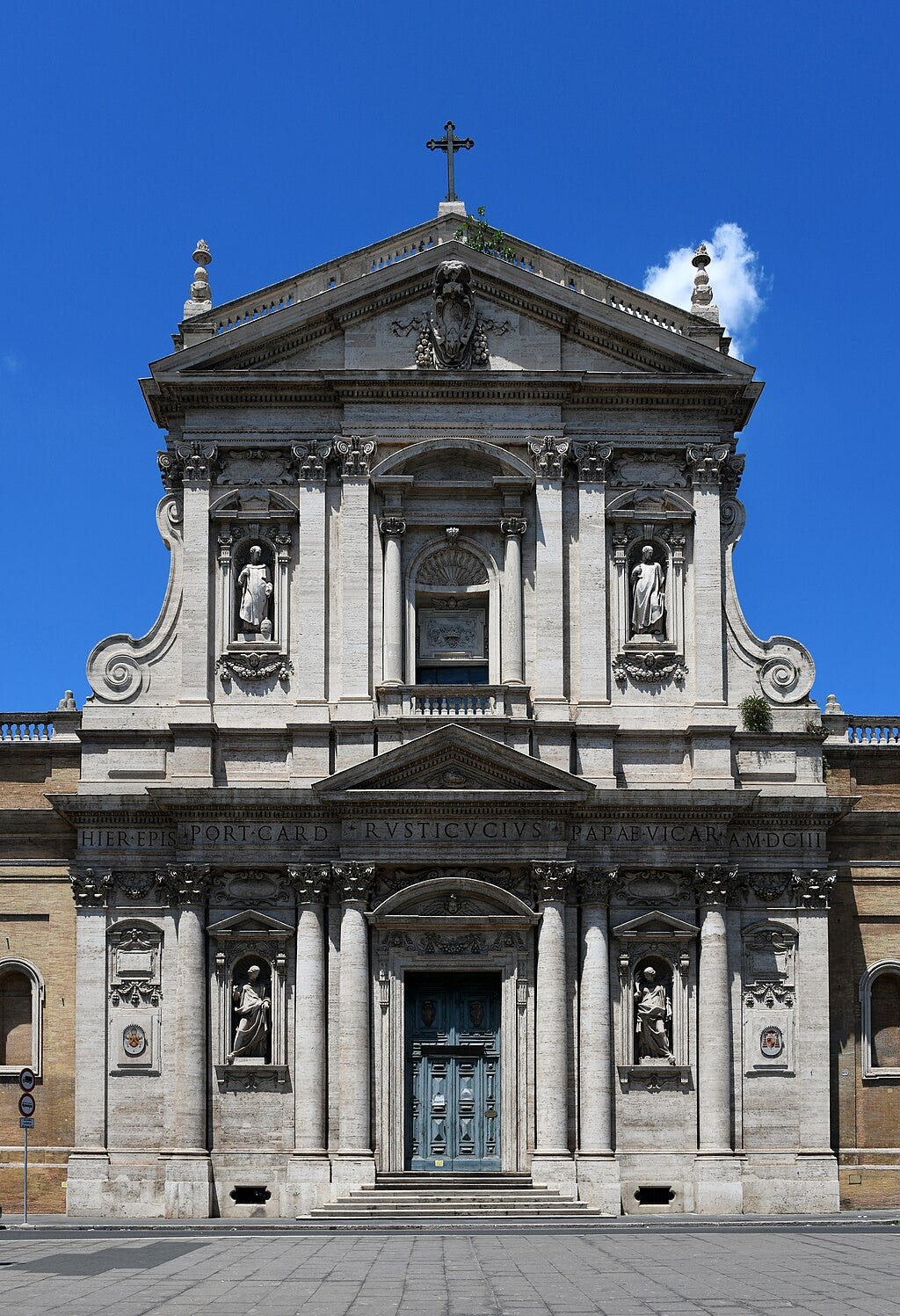
Born in Rome likely around the middle of the 8th century, the future Pope Leo III was in service to the Church for many years, ultimately being named cardinal-priest of Santa Susanna by Pope Adrian I, and also serving as his vestararius – the title given to managers of the medieval vestiarium, which oversaw papal finances as well as the papal wardrobe – hence the same etymological root as the words “vestment” as well as “INvestment.”
By that point in history such a role was a core figure in the papal court, so Leo was almost certainly as close a confidant to Adrian I as any other official. So it should have come as no surprise when he was voted unanimously to replace his old boss, immediately following Adrian’s death and burial on December 26, 795.
The speedy selection, aside from Leo being the obvious choice, has been speculated as having been done to prevent any undue influence by the Franks or the Lombards in papal affairs. At any rate, a letter and homage was sent to Charlemagne, the great king of the Franks.

Here I’ll take a quick minute to zoom us out and give a bit of context for who Charlemagne was, and where he came from. The Franks were a Germanic tribe from which sprang several iconic defenders of the Church, beginning with Clovis in the fifth century, down through the great Charles Martel, Charlemagne’s grandfather, who successfully beat back the invading Islamic Moors in 732 at Poitiers.
Charlemagne’s father, Pepin the Short, was crowned by the great St. Boniface – founder of the Christmas tree tradition, oddly enough – was named by Pope Stephen II as being the only royal line of the Franks, and was the progenitor of what became known as the Papal States after driving the Lombards from northern and Central Italy in the mid 8th century.
And so it’s no wonder that Charlemagne, coming from such formidable stock, became the greatest of these Carolingian kings. H.E. Crocker writes in his book Triumph:
“A strong, handsome and vigorous military prince, [Charlemagne] had all the barbarian virtues, an army and imperial policy unmatched since the days of the Roman legions and a sword consecrated to the Church. It is estimated that he fought more than 50 campaigns from one end of Western Europe to the other, often with the express goal of defeating and converting heathen tribes who would as soon burn a missionary as listen to the Gospel. Charlemagne waged campaigns to the east against the Avars, to the north against the Saxons and the Vikings, and to the south, across the Pyrenees against the Moors, a campaign that would later be immortalized in the Song of Roland. His Frankish armies fought throughout Italy, southern Germany, and the islands of the Mediterranean. His goal was that of all warrior kings, conquest, but also conversion of the conquered to the Catholic faith.”
Now, it’s easy for our modern ears to hear that and scoff or oversimplify.
But take the letter which Charlemagne sent back to the newly-elected pontiff, for instance:
“My task, assisted by the divine piety, is everywhere to defend the Church of Christ, abroad by arms against pagan incursions and the devastations of such as break faith, at home by protecting the Church in the spreading of the Catholic faith. Your task, Holy Father, is to raise your hands to God like Moses to ensure the victory of our arms, helped us by your prayers to God, ruler and giver of all, the populus Christianus may always and everywhere have the victory over the enemies of his holy name and the name of our Lord Jesus Christ resound throughout the world. May your prudence adhere in every respect to what is laid down in the canons and ever follow the rules of the Holy Fathers. Let the sanctity of your life and words be a shining example to all men.”
Charlemagne, a singular figure of history, though not without his faults, was genuine in his desire to link arm in arm with the pope of Rome, and was clearly convicted in the high calling that Leo III possessed as Vicar of Christ.
A few years into his papacy – whether out of jealousy, ambition, or a misguided thought that only the nobility should ascend to the See of Peter – Leo was attacked by a cadre of enemies as he led a procession on April 25, 799. As he approached the Flaminian Gate – now known as the Porta del Popolo in Rome – the pope was dragged from his horse and thrown to the ground, where his persecuters attempted to gouge out his eyes and cut out his tongue. He was rescued by two of Charlemagne’s men and carried off to the monastery of St. Erasmus on the Coelian to recover. It’s well-documented that Leo III miraculously recovered use of both his sight and his speech, and was been immortalized in the epic poem Karolus Magnus et Leo Papa, also known as the Paderborn Epic.
From there Leo fled over the Alps to Paderborn in the north of modern-day Germany, where Charlemagne had made camp. The libelous accusations had beaten Leo there, but even still Charlemagne welcomed the pope graciously, and insisted he be escorted back to Rome with an army, and his accusers put on trial. Unable to establish the pope’s guilt or their own innocence, the men were convicted and sentenced to death. But Leo, to his great credit, intervened to stay their execution and instead have them exiled permanently.
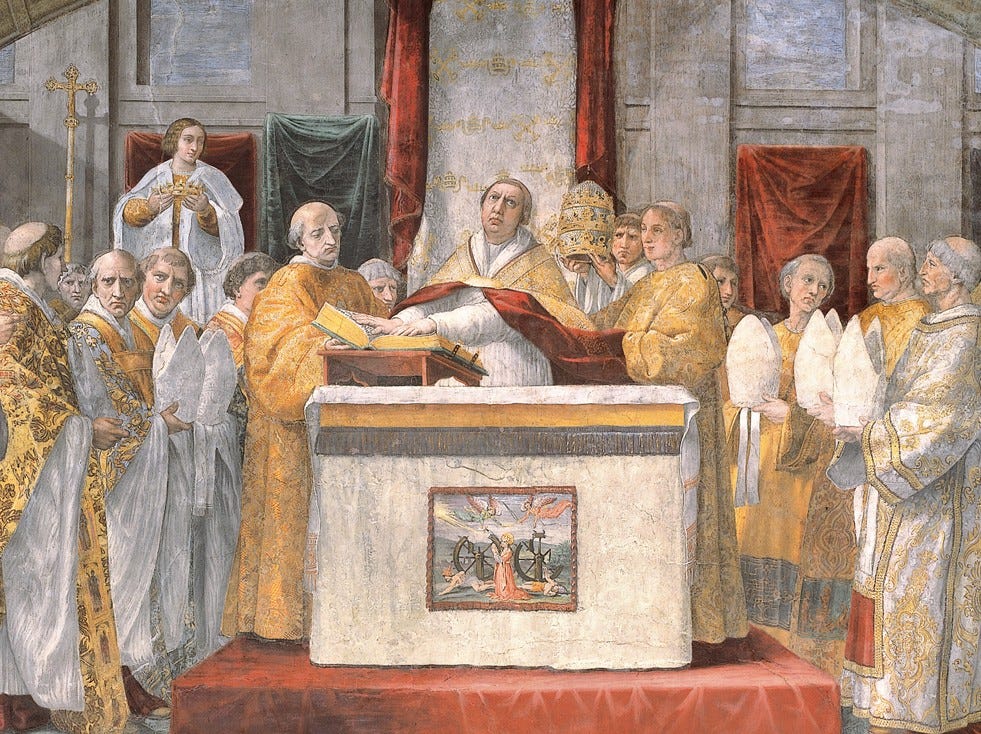
Not long after, on Christmas Day in the year 800, Charlemagne traveled to Rome and, kneeling in St. Peter’s Basilica, had a crown placed upon his head by Leo III, who declared him Holy Roman Emperor.
As Dr. Matthew Bunson writes in The Pope Encyclopedia, “Through this act, Leo established the custom of having all Holy Roman Emperors receive their crowns from the pope. Leo gave to the papacy a powerful privilege while allying it closely to the Western Roman Empire, thereby ending forever any reliance upon the Byzantines, long the protectors of the Holy See.”
Not only had the pope basically declared that the world was now subject to a single temporal ruler, but practically speaking he and Charlemagne would be inextricably linked for the remainder of both of their reigns.
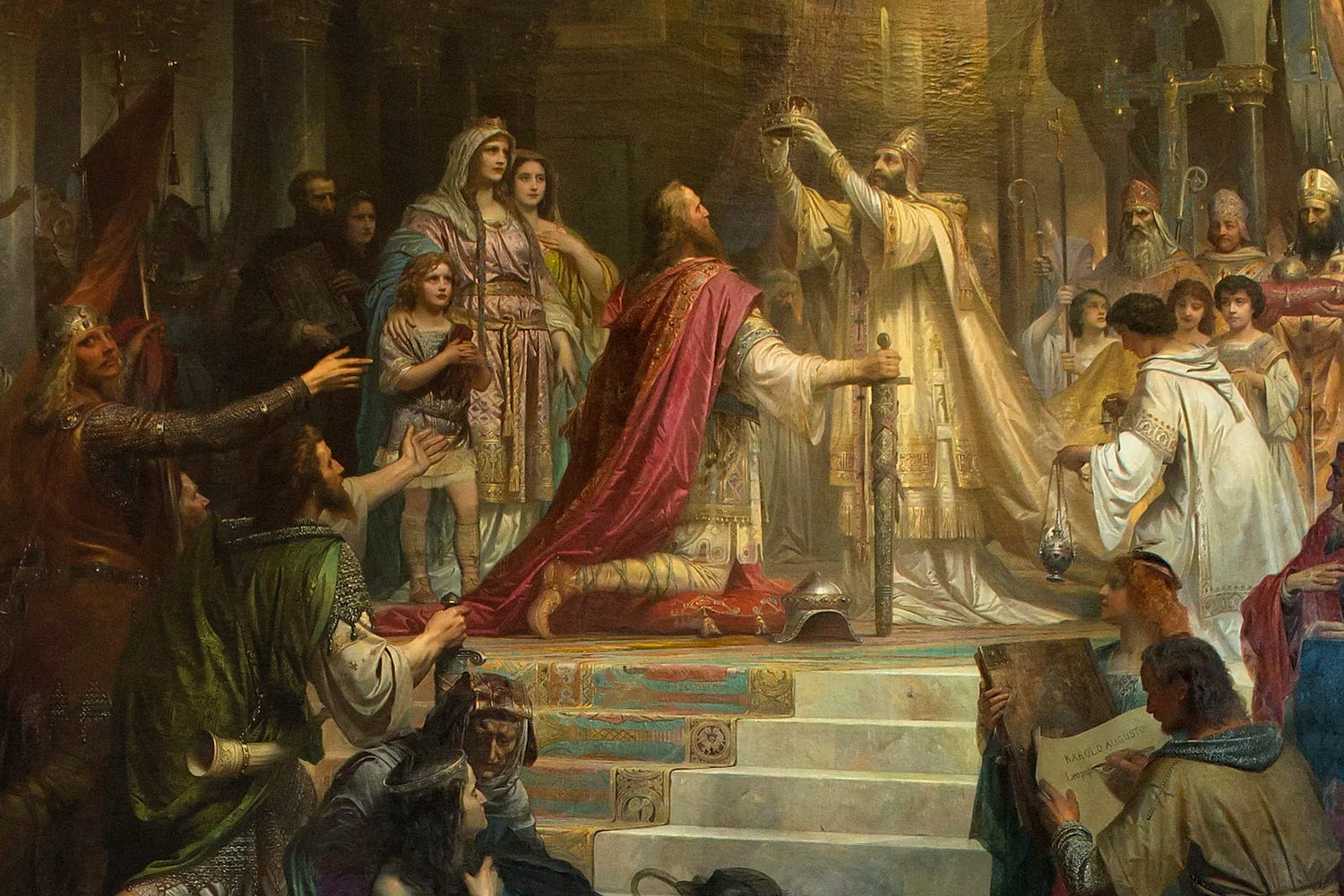
And all mostly went well, save for the emperor getting out over his skis in declaring that the filioque clause – that the Holy Spirit proceeded from the Father AND FROM THE SON – should be inserted into the Nicene Creed. There was nothing wrong with such a change, technically speaking, and Charlemagne in his zeal simply considered it essential to explicating the true faith among the western tribes. But Leo, despite saying that “it is forbidden not to believe such a great mystery of the faith”, nevertheless was hesitant to change a creed that was so divinely illuminated from the council fathers nearly 5 centuries prior, considering that there were many other items necessary for salvation that also didn’t appear in the creed.
Elsewhere in his pontificate, Leo paid particular attention to disputes in England - laymen were forbidden from being appointed head of monasteries, he excommunicated King Eadbert Praen for seizing the throne of Kent, and he restored the Archdiocese of Canterbury’s boundaries to that set originally by St. Gregory the Great. Leo also was called to intervene in a nasty and prolonged spat between Archbishop Wulfred and King Cenulf of Mercia. Apparently, the latter was so greedy that he went as far as illicitly speaking in the name of the pope in order to steal gold from both the Archbishop and the nearby monastery of Abingdon.
The threat of mortal peril once again returned to the pope’s doorstep, however, once Charlemagne died in January of 814, but at least this time Leo was ready for it. He wasn’t quite so merciful this time around, either, because he made sure the chief collaborators were caught and summarily executed – perhaps feeling the need for a show of strength in the absence of his departed collaborator.
A second plot arose shortly thereafter, with a group of nobles from Campagna set to march on Rome after plundering their own region, but the effort was put down by armies of the Duke of Spoleto and Langobardia, the King of Italy.
On the home front, Leo III was able to make great use of the generosity of Charlemagne by both providing efficiently to the poor and continuing the long papal tradition of renovating and beautifying historical churches around Rome, in particular decorating his former titular church of Santa Susanna with glorious mosaics, one of which bore his own image until the end of the 16th century.
Leo III died on June 12, 816 after a reign of roughly 20 years and 6 months. At the time he had the 4th longest papacy after St. Peter himself, one of which, oddly enough, was his immediate predecessor Adrian I, who was in the Chair of St. Peter for almost 24 years.
It’s particularly wild to think that two men occupied 44-odd years all by themselves, considering the Church changed popes in those days like a baby’s dirty diapers.
Leo III was laid to rest in St. Peter’s Basilica, originally in his own tomb, but his relics were later moved into a tomb containing all four of the first Popes Leo. He was canonized in 1673 by Pope Clement X.
Following the completion of the new St. Peter’s Basilica, the relics of Pope St. Leo the Great were moved to a chapel dedicated to him, but the four holy Leos still occupy the same chapel to the left of the Altar of the Chair to this day
To wrap things up, as providence would have it, Pope St. Leo III has an amusing connection to our present moment.
On the north side of the Piazza of the Basilica of St. John Latern in Rome sits the Triclinium Leoninum, a beautiful freestanding apse mosaic depicting, on one side, Christ giving the keys to Peter and a standard to Constantine, and on the other side St. Peter giving the pallium to Leo III and a standard to Charlemagne.
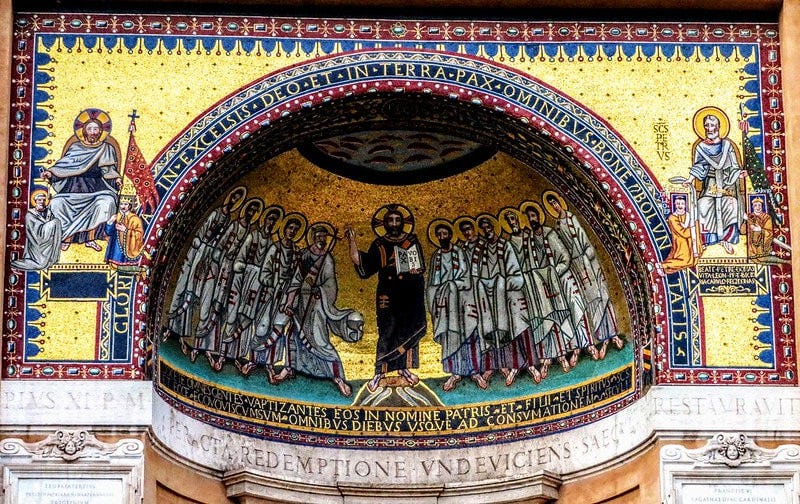
The monument was commissioned by Benedict XIV in the 1700s as an homage to a large BANQUET HALL that Leo III constructed alongside the Lateran Basilica in order to provide a space to hold large official banquets. Called a “Triclinium”, it was modeled on the rooms of the imperial palace of Constantinople, decorated with mosaics and lined with marble.
Granted, Leo’s was only about half the size of the one currently under construction in Washington DC, but isn’t history full of surprises nonetheless?
Thanks for reading (and listening and subscribing).
Pope St. Leo III, pray for us!